
Three layers
"Money" is not a single thing. It is a set of liabilities with different degrees of liquidity and different issuers. The standard aggregates try to capture that hierarchy.
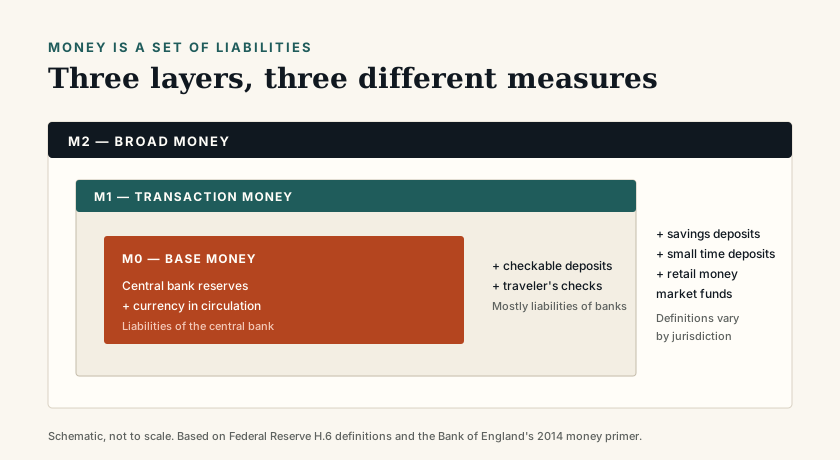
Base money and broad money
Base money, also called M0 or central-bank money, consists of currency in circulation and reserve balances held by commercial banks at the central bank. It is the liability of the central bank and the settlement asset of the system.
Broad money is the money held by households and firms: deposits at commercial banks and similar institutions. In a modern economy, broad money is much larger than base money. That is not an accident; it is a consequence of bank credit creation.[1]
The relationship between the two is not a fixed multiplier. The central bank supplies reserves to meet demand and to implement policy. Banks create deposits when they lend. The aggregates move together in complex ways, shaped by credit demand, regulation, and the central bank's operating framework.
What M1 and M2 include
The exact definitions vary by country and are revised from time to time. In the United States, the Federal Reserve publishes the following broad categories:[2]
| Measure | Main components | What it is trying to capture |
|---|---|---|
| M0 / base money | Currency in circulation + reserve balances | The central bank's liabilities and the settlement asset |
| M1 | Currency + checkable deposits + traveler's checks | Money used for transactions |
| M2 | M1 + savings deposits + small time deposits + retail money market funds | Broader store-of-value money held by households and firms |
The IMF's manual provides a common framework for monetary and financial statistics, but national definitions still differ.[3] A dollar of M2 in the United States is not the same instrument mix as a euro-area aggregate with a similar label.
Why the multiplier story is misleading
The textbook money multiplier says that a given stock of reserves supports a multiple of deposits, determined by the reserve ratio. In that model, the central bank controls the money supply by controlling reserves.
Modern central banks do not operate that way. They set a policy rate and supply reserves elastically. The reserve requirement is often zero or non-binding. Banks create deposits when they lend and obtain reserves for settlement afterward. The quantity of reserves is largely a by-product of the central bank's asset purchases, lending facilities, and the banking system's demand for safe balances.[4]
This does not mean the money supply is irrelevant. It means the causal story is different from the textbook one. Credit creation, not a mechanical reserve multiplier, is the main driver of broad money growth.
Velocity
The velocity of money is the ratio of nominal spending to the money stock. If money changes hands quickly, a given stock can support more transactions. If households and firms hoard money, velocity falls.
Velocity is not a constant. It can change with interest rates, uncertainty, payment technology, and the demand for safe assets. A fall in velocity can offset an increase in the money stock, which is one reason the relationship between money growth and inflation is not stable in the short run.
How to read the data
When looking at money-supply data:
- Check the definition and the date. Series are revised.
- Distinguish nominal from real balances. Inflation changes what the numbers mean.
- Look at growth rates, not just levels.
- Compare money growth with credit growth, nominal GDP, and interest rates.
- Be careful with cross-country comparisons. Definitions and financial structures differ.
- Remember that correlation is not causation. Money growth and inflation can be linked without running in a simple one-way causal chain.
The Federal Reserve's H.6 release and FRED provide the underlying series.[2] [5] The Friedman-Schwartz monetary history remains a classic reference for the long-run relationship between money and economic activity, but it should be read alongside later research on credit, financial structure, and the endogeneity of money.[6]
Where to go next
- Money creation — the balance-sheet mechanics.
- The Federal Reserve — how reserves are supplied.
- Monetary policy — how the policy rate transmits.
- Macroeconomics — how money and credit interact with output.
Sources
- Bank of England. Money in the modern economy: an introduction. Bank of England Quarterly Bulletin. 2014. View source Accessed Nov 11, 2026.
- Board of Governors of the Federal Reserve System. Money Stock Measures (H.6). Federal Reserve. 2026. View source Accessed Nov 11, 2026.
- International Monetary Fund. Monetary and Financial Statistics Manual. IMF. 2000. View source Accessed Nov 11, 2026.
- Keister, Todd; McAndrews, James. Why Are Banks Holding So Many Excess Reserves?. Federal Reserve Bank of New York, Current Issues in Economics and Finance. 2009. View source Accessed Nov 11, 2026.
- Federal Reserve Bank of St. Louis. FRED Economic Data. FRED. 2026. View source Accessed Nov 11, 2026.
- Friedman, Milton; Schwartz, Anna J.. A Monetary History of the United States, 1867–1960. Princeton University Press. 1963. View source Accessed Nov 11, 2026.